Interview multiple candidates
Lorem ipsum dolor sit amet, consectetur adipiscing elit proin mi pellentesque lorem turpis feugiat non sed sed sed aliquam lectus sodales gravida turpis maassa odio faucibus accumsan turpis nulla tellus purus ut cursus lorem in pellentesque risus turpis eget quam eu nunc sed diam.
Search for the right experience
Lorem ipsum dolor sit amet, consectetur adipiscing elit proin mi pellentesque lorem turpis feugiat non sed sed sed aliquam lectus sodales gravida turpis maassa odio.
- Lorem ipsum dolor sit amet, consectetur adipiscing elit.
- Porttitor nibh est vulputate vitae sem vitae.
- Netus vestibulum dignissim scelerisque vitae.
- Amet tellus nisl risus lorem vulputate velit eget.
Ask for past work examples & results
Lorem ipsum dolor sit amet, consectetur adipiscing elit consectetur in proin mattis enim posuere maecenas non magna mauris, feugiat montes, porttitor eget nulla id id.
- Lorem ipsum dolor sit amet, consectetur adipiscing elit.
- Netus vestibulum dignissim scelerisque vitae.
- Porttitor nibh est vulputate vitae sem vitae.
- Amet tellus nisl risus lorem vulputate velit eget.
Vet candidates & ask for past references before hiring
Lorem ipsum dolor sit amet, consectetur adipiscing elit ut suspendisse convallis enim tincidunt nunc condimentum facilisi accumsan tempor donec dolor malesuada vestibulum in sed sed morbi accumsan tristique turpis vivamus non velit euismod.
“Lorem ipsum dolor sit amet, consectetur adipiscing elit nunc gravida purus urna, ipsum eu morbi in enim”
Once you hire them, give them access for all tools & resources for success
Lorem ipsum dolor sit amet, consectetur adipiscing elit ut suspendisse convallis enim tincidunt nunc condimentum facilisi accumsan tempor donec dolor malesuada vestibulum in sed sed morbi accumsan tristique turpis vivamus non velit euismod.
Why Electricity Cost Is the First Question People Ask
When venues consider installing free phone charging, the conversation often starts in the same place:
“How much is this going to cost us in electricity?”
It’s understandable. Energy prices have been unpredictable, and no one wants to introduce a new ongoing expense without knowing what it looks like.
At the same time, expectations have changed. Visitors now assume they can charge their phones in airports, hospitals, stadiums and public spaces. Low battery doesn’t just cause mild inconvenience — it can cause real stress.
So the real question becomes:
Is the electricity cost meaningful enough to justify hesitation?
Or is it small enough that the benefit far outweighs it?
The rest of this article walks through the numbers clearly and calmly — so you can see the answer for yourself.
Do Standing Charges Affect the Cost?
Business electricity bills include:
- A unit rate (price per kWh used)
- A standing charge (a fixed daily fee)
For this analysis, we ignore standing charges.
You are already paying them whether phone charging exists or not. Installing charging shelves or totems does not create an additional standing charge — it simply adds a small amount of extra usage.
So we focus only on what changes: electricity consumption.
How Much Electricity Does Phone Charging Use?
Most smartphones draw around 10 watts while actively charging.
For context:
- LED light bulb: 8–12 watts
- Laptop charger: 45–65 watts
- Hand dryer: 1,000+ watts
- Kettle: 2,000–3,000 watts
Phone charging sits at the very low end of everyday electrical loads.
For simple maths:
10 watts = 0.01 kilowatts (kW)
How Long Does a Typical Public Charging Session Last?
In real-world venues — hospitals, airports, stadiums — most people are topping up rather than charging from 0% to 100%.
A practical average session length is:
15 minutes (0.25 hours)
This already reflects real behaviour, including slower cables and shorter dwell times.
What Is a Realistic UK Electricity Price in 2026?
Business electricity rates vary by contract, but a sensible working figure for 2026 is:
£0.26 per kWh (26p)
Your exact rate may differ slightly. It won’t materially change the conclusion.
What Is the Cost of One Phone Charge?
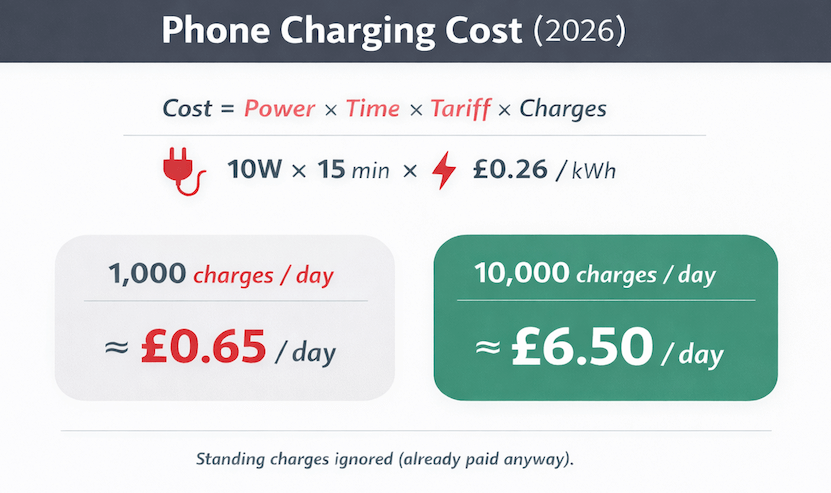
The formula:
Cost = Power × Time × Tariff
So:
0.01 kW × 0.25 hours × £0.26
= £0.00065
That’s:
0.065 of a penny
In simple terms:
A 15-minute charge costs less than one tenth of a penny.
What Does 1,000 Charges Per Day Cost?
Let’s use a realistic large-venue example.
1,000 charges × £0.00065
= £0.65 per day
Sixty-five pence.
This is typical of busy hospitals, airport concourses and waiting areas where charging shelves are installed to support visitors.
Electricity cost is rarely the limiting factor.
What About 10,000 Charges Per Day?
Let’s look at an extreme scenario.
10,000 charges × £0.00065
= £6.50 per day
Even at very high usage — major event days or peak travel times — the electricity cost remains modest.
Large open spaces often use charging totems to allow multiple users to charge simultaneously without crowding.
Even at that scale, power consumption remains small.
Does Wireless Charging Increase the Cost?
Charging stations typically include:
- USB ports
- Plug sockets
- Wireless charging pads
Not every device uses wireless charging.
Wireless charging can be slightly less efficient, and devices are not always perfectly aligned. Even allowing for up to 20% additional energy use, the cost increase is small:
- 1,000 charges per day → around 78p
- 10,000 charges per day → around £7.80
The wattage involved is simply too small to create a meaningful spike in electricity bills.
Do Slow Cables or Older Devices Increase Electricity Use?
No.
If someone uses an older cable and charges more slowly, the phone simply draws power at a lower rate for slightly longer. The total energy used for a short top-up remains within the same sensible range.
That’s already reflected in the 15-minute average used here.
Putting It Into Perspective
10,000 phone charges per day costs roughly £6.50 in electricity.
That’s comparable to:
- Running a 1kW heater for 6–7 hours
- A minor lighting adjustment
- A small HVAC runtime change
In most venues, heating, cooling and lighting consume vastly more electricity than phone charging.
The Bigger Question: Cost vs Experience
When someone’s phone battery is low in a hospital, airport or stadium, it creates genuine anxiety.
Phones now hold:
- Boarding passes
- Tickets
- Payment methods
- Directions
- Emergency contacts
Providing free charging meaningfully reduces stress.
Solutions such as public phone charging shelves in waiting areas or free-standing charging totems in high-footfall zones allow venues to deliver that reassurance easily.
The electricity cost to do so is:
- Pennies per day at moderate usage
- Single-digit pounds per day even at extreme usage
When compared to the anxiety relieved for visitors, the cost is minimal.
Final Conclusion
Using realistic 2026 electricity pricing:
- One 15-minute charge costs less than one tenth of a penny
- 1,000 charges per day cost about 65p
- 10,000 charges per day cost about £6.50
- Standing charges are paid regardless
The fear that free phone charging will significantly increase electricity bills is not supported by the maths.
For venues, the improvement in visitor satisfaction and reduced anxiety far outweighs the tiny additional energy cost.
Electricity should not be the barrier.
FAQ
How much electricity does phone charging use?
A typical phone uses around 10 watts while charging, making it a very small electrical load.
How much does 1,000 phone charges cost per day?
At 26p per kWh, approximately 65 pence per day.
Does wireless charging use more electricity?
Slightly, but even allowing for 20% inefficiency, the daily cost increase remains small.
Are standing charges included?
No. Standing charges are paid regardless and are unaffected by installing charging stations.


Join our mailing list
Sign up to our mailing list to be informed of relevant updates and insights from Crable.