Interview multiple candidates
Lorem ipsum dolor sit amet, consectetur adipiscing elit proin mi pellentesque lorem turpis feugiat non sed sed sed aliquam lectus sodales gravida turpis maassa odio faucibus accumsan turpis nulla tellus purus ut cursus lorem in pellentesque risus turpis eget quam eu nunc sed diam.
Search for the right experience
Lorem ipsum dolor sit amet, consectetur adipiscing elit proin mi pellentesque lorem turpis feugiat non sed sed sed aliquam lectus sodales gravida turpis maassa odio.
- Lorem ipsum dolor sit amet, consectetur adipiscing elit.
- Porttitor nibh est vulputate vitae sem vitae.
- Netus vestibulum dignissim scelerisque vitae.
- Amet tellus nisl risus lorem vulputate velit eget.
Ask for past work examples & results
Lorem ipsum dolor sit amet, consectetur adipiscing elit consectetur in proin mattis enim posuere maecenas non magna mauris, feugiat montes, porttitor eget nulla id id.
- Lorem ipsum dolor sit amet, consectetur adipiscing elit.
- Netus vestibulum dignissim scelerisque vitae.
- Porttitor nibh est vulputate vitae sem vitae.
- Amet tellus nisl risus lorem vulputate velit eget.
Vet candidates & ask for past references before hiring
Lorem ipsum dolor sit amet, consectetur adipiscing elit ut suspendisse convallis enim tincidunt nunc condimentum facilisi accumsan tempor donec dolor malesuada vestibulum in sed sed morbi accumsan tristique turpis vivamus non velit euismod.
“Lorem ipsum dolor sit amet, consectetur adipiscing elit nunc gravida purus urna, ipsum eu morbi in enim”
Once you hire them, give them access for all tools & resources for success
Lorem ipsum dolor sit amet, consectetur adipiscing elit ut suspendisse convallis enim tincidunt nunc condimentum facilisi accumsan tempor donec dolor malesuada vestibulum in sed sed morbi accumsan tristique turpis vivamus non velit euismod.
Across airports, hospitals, coffee shops, stadiums and large-scale events, one behaviour is now consistent. People move through these environments with their phone in hand, using it to navigate, to pay, to access information, to stay connected and increasingly to engage with the space around them.
A huge amount of time goes into designing these environments around behaviour. Footfall is mapped, flow is optimised, dwell time is analysed and commercial opportunities are carefully positioned. Entire teams exist to understand how people move and interact within a space and how that movement can be shaped.
And yet, despite all of that effort, one dependency still sits slightly outside the design process.
A charged phone.

It’s not a new idea, and it doesn’t need explaining. Everyone recognises the moment when their battery starts running low. Behaviour shifts, often subtly at first. Visits get cut short, decisions are delayed, certain actions are avoided altogether.
Individually, these are small changes. At scale, they have a meaningful impact on how a space performs.
Most venues do have charging. The issue is not its absence, but how it has been introduced. In many cases it has been added late in the process, placed wherever there happens to be space rather than where it genuinely supports behaviour.
That distinction matters more than it might seem.
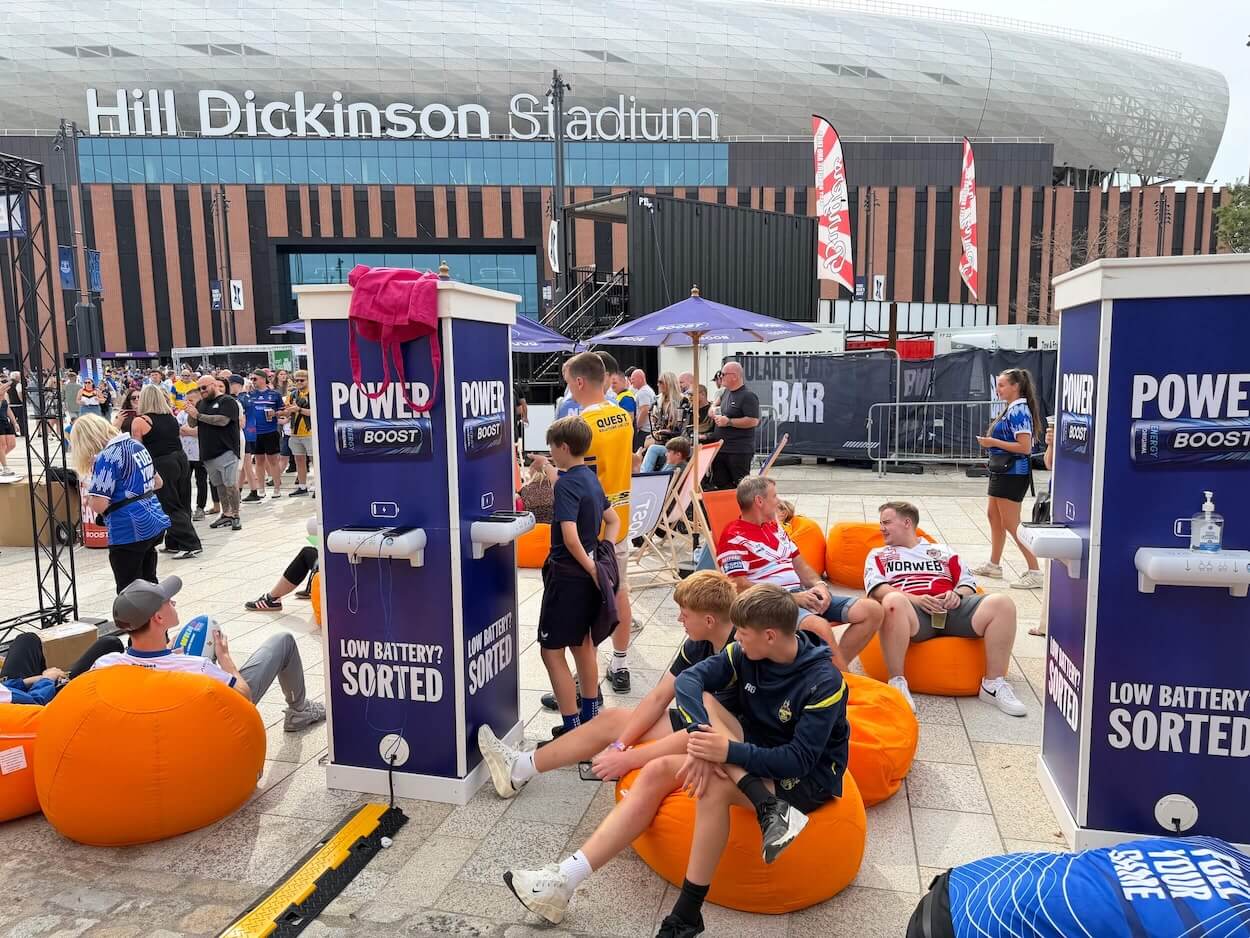
Look across different environments and the pattern is hard to miss. In a stadium, fans are checking tickets on the way in, ordering food at half time and sharing moments as they happen. In an airport, passengers are managing boarding passes, considering upgrades and making decisions at the gate. In hospitals, phones are central to communication, information and often emotionally significant moments. In coffee shops, they sit behind ordering, payment, loyalty and the decision to stay longer.
Different environments. Same dependency.

People arrive with a charged phone, use it throughout their time in a space and gradually run it down. The longer they stay, the more it matters. The more reliant the experience is on mobile, the more noticeable the drop-off becomes when battery levels start to fall.
It’s rarely a dramatic moment. No one announces that their phone is about to die. But behaviour changes. Engagement reduces, decisions are postponed and in some cases, visits end earlier than planned.
These shifts are easy to miss in isolation, but across thousands of people they add up quickly.
Charging, in this context, is not simply about availability. It is about placement.
Much of the infrastructure seen today has been positioned reactively. A spare wall, an unused corner, a gap that feels like it can be filled. From a practical point of view, that provides a solution.
From a behavioural point of view, it often misses the mark entirely.
People do not decide to charge their phone because they notice a unit. They do it when it aligns with what they are already doing — when they are waiting, when they are stationary, or when there is a natural pause in their journey. It might be at a gate, in a concourse, within a queue or at a point where a decision is about to be made.
This is where the difference between space and behaviour becomes clear.
Not dead space. Decision space.

When charging is positioned without that context, it creates friction rather than removing it. People gather in areas that were never designed for dwell, sit on the floor near sockets or simply ignore what is available because it is not where they need it to be.
It is present, but it is not useful in the moments that actually matter.
The impact of that goes beyond convenience. If someone is thinking about their battery, they are less likely to engage fully with the space around them. Browsing reduces, transactions are delayed and opportunities are missed.
Not through lack of intent, but through lack of reliability.
One of the more positive aspects of this is that it does not require a fundamental redesign of a space. Charging infrastructure can be introduced into existing environments with relatively little disruption, even in complex, high-footfall locations.
That flexibility makes it accessible.
What still requires thought is where it is placed.
When it is positioned correctly, it rarely stands out. Like most well-considered design, it blends into the environment and becomes part of how the space functions rather than something separate from it.
The difference is visible in behaviour.
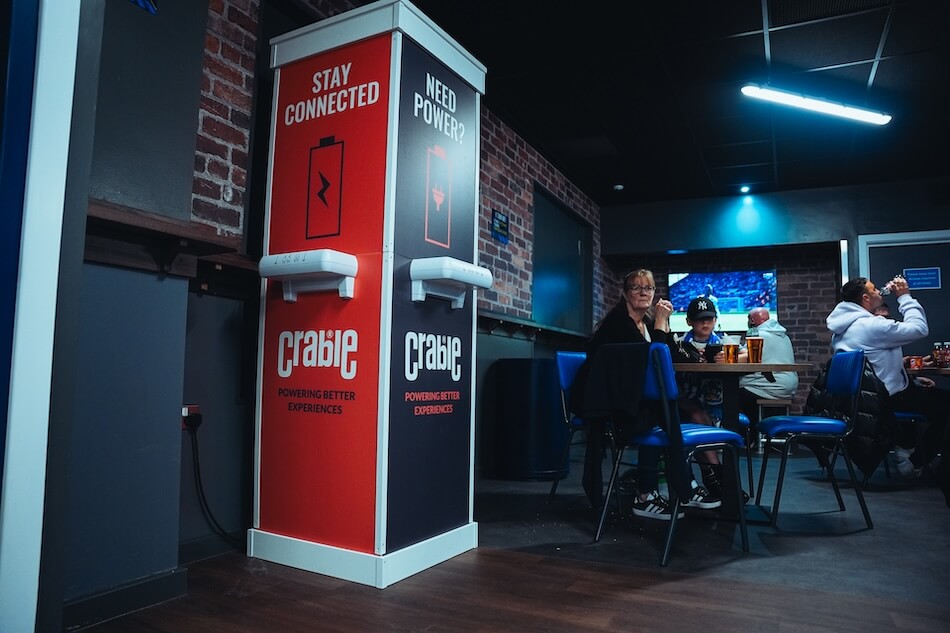
In a stadium, it allows fans to stay engaged through half time rather than stepping away from the experience. At an airport gate, it supports decision-making at a point where attention and intent are already high. In hospitals, it enables communication and access to information without interruption. In hospitality environments, it extends dwell time and supports continued interaction.
None of this is dramatic, but it is consistent.
This is not about introducing new behaviour. It is about allowing the behaviour that already exists to continue without unnecessary friction.
Once that foundation is in place, a further layer of opportunity becomes visible. People are stationary, engaged and already using their device. The barrier to interaction has been removed, which changes what becomes possible in that moment.

In a stadium, that might mean ordering without leaving a seat. At an airport, it could be engaging with an upgrade or service at the gate. In a hospital, it may involve responding to information or completing a donation when the moment feels right.
These are not new behaviours.
They simply depend on a phone that works.
Seen in that light, charging becomes more than a utility. It becomes a point of connection between physical space and digital interaction, supporting actions that are already taking place rather than trying to create new ones.
That is where the real opportunity sits.
At Crable, charging is treated as foundational infrastructure. The hardware ensures it is reliable, visible and positioned where it aligns with behaviour. On top of that sits Sticky, enabling simple interactions such as tap-to-order, loyalty, upgrades or donations at the moments they are most relevant.
It works because the moment already exists.
Ultimately, this is not about adding something new into a space.
It is about making better use of something that is already there.


Join our mailing list
Sign up to our mailing list to be informed of relevant updates and insights from Crable.